Agents in Financial Operations, with Sequence, Ramp and Campfire
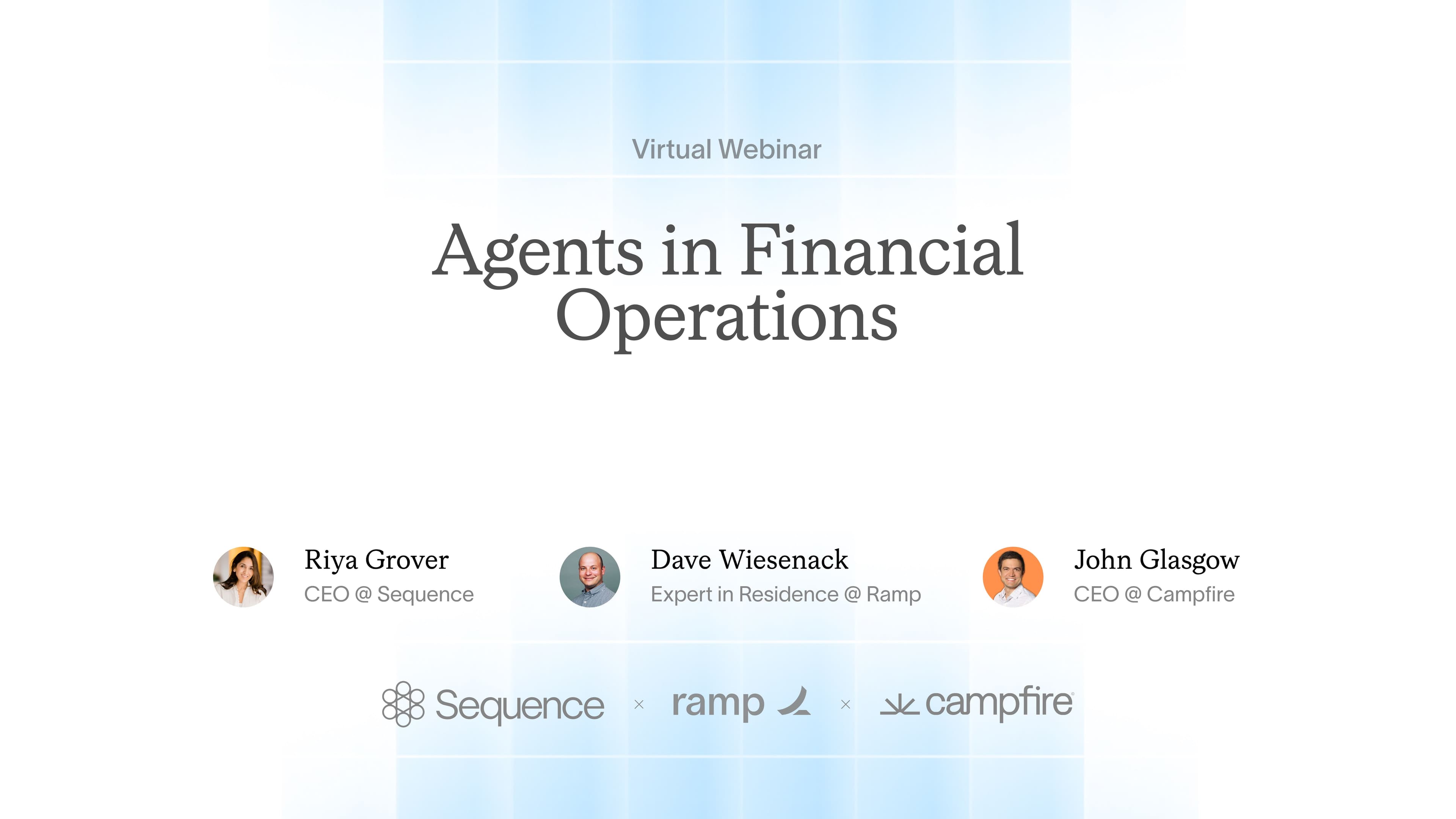
Hear from Riya Grover (Sequence), Dave Wieseneck (Ramp) and John Glasgow (Campfire), as they demo agentic workflows across the finance stack and dive into how AI agents are reshaping finance operations. The conversation revealed how three companies are moving beyond traditional chatbots to embed intelligent agents directly into critical finance workflows.
Chatbots aren’t the solution for finance teams
Dave opened with a sharp observation about why AI adoption in finance has been slower than expected. The familiar "ask anything" chatbot interface forces finance professionals to become prompt engineers, creating writer's block rather than productivity gains. The real opportunity lies in embedding AI directly into existing workflows within systems like Ramp, Sequence, and Campfire.
This shift represents a fundamental change in software design. Instead of building systems for humans to navigate, we're configuring agents that learn to use the software themselves. Rather than simple, rule-based automations, these agents can reason, access context, and make decisions a human would make.
Three demos of agentic workflows across the finance stack
Each company demonstrated their approaches to agent-powered finance workflows:
Ramp's Policy Agent handles expense management by automatically reviewing transactions against company expense policies. The system processes thousands of transactions while consistently applying policy rules that human managers often struggle to remember or apply uniformly. Dave showed how the agent handles 80-90% of transactions autonomously, only sending the 10-15% requiring human judgment. The agent can even detect AI-generated receipts and flag policy violations like banned gift card purchases.
Sequence's Revenue Agents address the order-to-cash workflow through three specialized agents. The contract intake agent processes sales contracts in real-time, pulling out complex pricing structures including tiered usage models, free trial periods, and minimum commitments. Our revenue recognition agent checks data to ensure edge cases are handled correctly, while the dunning agent manages collections by learning company-specific customer communication preferences and automatically flagging exceptions like high-value invoices or recently onboarded customers.
Campfire's General Ledger Agents support month-end close workflows, from bank reconciliations to creating journal entries. John demonstrated agents that audit human work before period close, automatically flagging miscoded transactions like insurance expenses coded as software. The system also drafts flux commentary by analyzing transaction data and creates accruals using three-month trailing averages, all while keeping complete audit trails.
Building trust: why companies should treat AI like new employees
All three companies built extensive oversight features, treating agents like new employees requiring supervision before gaining independence. Dave emphasized starting with low-risk, repeatable workflows where individual decisions carry minimal material impact. As agents show consistent performance through audit features, teams gradually increase their autonomy.
The approach mirrors human onboarding: review work extensively in early weeks, understand reasoning patterns, then give more independence. For high-risk decisions involving strategic judgment, agents provide analysis and recommendations while humans make final decisions.
Riya highlighted an often overlooked point about human mistakes. Finance teams regularly under-bill revenue, miss contract minimums, or let invoices sit unprocessed. Well-implemented agents excel at pattern detection and systematic execution, potentially reducing errors that people make due to fatigue or oversight.
Being close to transaction data enables agents to perform better
The discussion revealed a key insight about agent effectiveness: being close to transaction data creates better outcomes. Dave explained that agents need three elements to perform well: clear prompts, rich context, and access to appropriate tools. Companies closest to the source transaction (AP, AR, GL) have more detailed information to feed their agents.
Using an accounting pyramid analogy, Dave described how the transaction layer forms the foundation, followed by month-end close, reporting, and strategic finance. Ramp's position at the transaction layer provides access to PDFs, receipts, and invoice details that inevitably lose detail when passed downstream to other systems.
However, this creates an interesting future scenario. As agents become more sophisticated, they'll need to communicate across systems, sharing not just data but memory of previous decisions and reasoning. Dave suggested that just as humans context-switch between platforms, agents will eventually work together across the finance stack.
Agents will create substantially leaner finance teams
Looking forward, all three leaders see finance teams becoming much leaner. While one-person public company finance departments remain unlikely due to SOX compliance and separation of duties requirements, the transformation will be substantial.
John noted that companies preparing for IPO today might have 30-40 finance team members. That number will shrink significantly as agents handle transactional work, freeing employees for management, capital allocation, and strategic decision-making. The bottleneck isn't technical capability but regulatory acceptance of agents fulfilling one role in the two-person approval process required by SOX controls.
Riya outlined a likely evolution: today's single-task, semi-autonomous agents within individual platforms will progress to more autonomous single-task workflows, then multi-step workflows within platforms, and eventually inter-system agent communication. She expects this progression to unfold within five years.
Dave envisioned agents building memory just as humans do, remembering every transaction and the reasoning behind decisions. This institutional knowledge will flow downstream, enabling better flux analysis and strategic decisions based on accumulated context from upstream systems.
What this all means for finance leaders
The group highlighted several principles for finance leaders considering agent implementation:
- Start with high-volume, low-risk workflows where consistent rule application creates immediate value. Demand complete audit trails from any agent system, with clear reasoning for every decision. Build confidence gradually by treating agents like new employees who need supervision before independence
- Focus on context-rich environments where agents access detailed transaction data. Plan for multi-system coordination as agents eventually communicate across the finance stack. Remember that while 0% error rates remain non-negotiable in financial operations, agents often outperform humans on consistency and pattern detection
- Modern companies are pushing the boundaries of finance automation. As these tools mature, the finance function will transform from manual processing to agent management, fundamentally changing how teams operate and scale.
Watch the full discussion and live demos here.