Introducing the Sequence Finance Advisory Board
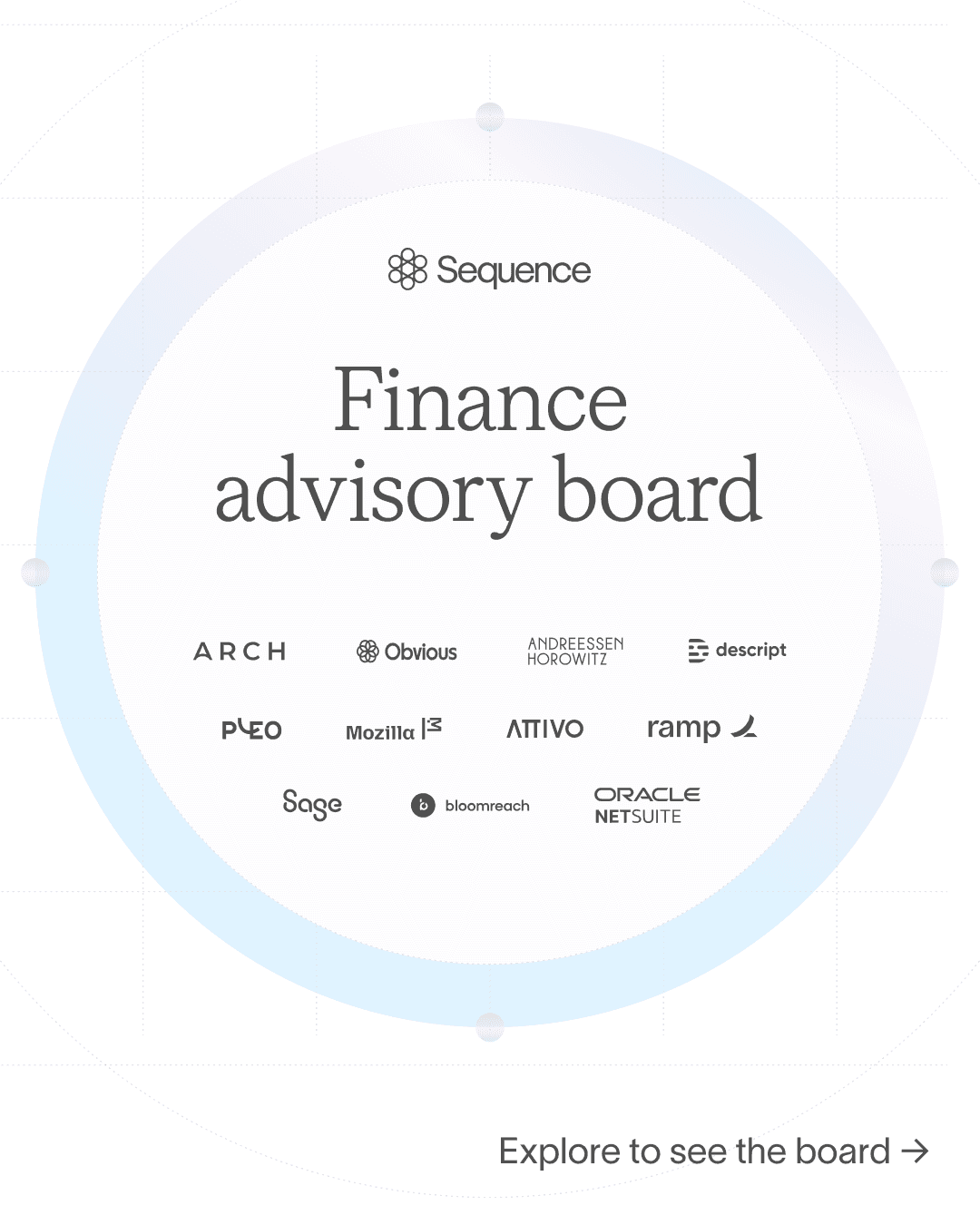
Twelve finance and revenue operations leaders have been working with us over the past several months. They've been in our advisory sessions, on our roadmap calls, and helping us cut through the noise in a category that's making it harder than it should be for teams to figure out what actually matters. Today we're making the Sequence Finance Advisory Board official.
Why we built the Finance Advisory Board
Billing and revenue infrastructure is one of the loudest categories in finance software right now. Every vendor sounds the same. Every demo lands the same. Buyers are being asked to evaluate platforms they've never bought before, with marketing on top of products that often can't deliver the basics.
We wanted a small group of leaders who've lived this. People who've sat through the pitches, run the implementations, and can tell us what's signal and what's noise. The Finance Advisory Board includes operators across SaaS, fintech, and AI companies, plus a few partners who see hundreds of finance stacks a year.
The board isn't a customer success forum. Several members aren't customers. The only requirement was that they'd be honest about the category, not just about us.
What actually matters in revenue automation
The most useful thing the board does is help us tune out the noise. A few things have come through clearly across sessions.
Most of the AI agent marketing right now is theatre. A wave of vendors are selling agents that sit on top of existing ERPs and claim to automate the finance workflow. When the board pressure-tested them, the reality was that those agents can't write back into the systems of record. They handle reconciliation at the edges and leave the actual work untouched. Useful agents have to be built into the system that owns the data, not bolted on outside it.
The wedge isn't AI. It's getting the foundations right. Custom contracts, complex pricing, usage-based edge cases, mid-quarter true-ups. The board kept coming back to the same point: any platform that can't model the contract accurately can't automate anything downstream. The companies that obsess over the engine, not the wrapper, are the ones worth paying attention to.
Implementation is the moat. Several members had migrated off platforms where the implementation failed or dragged on for a year. The thing that earns trust isn't features on a slide. It's a finance team going live in weeks, with their actual contracts, and never needing to call an engineer to fix a billing run.
Buyers don't always know what to ask for. First-time buyers tend to evaluate on surface features and AI demos. Second-time buyers come in with detailed RFPs and want to see edge cases. The category needs more help educating the first-time buyer on what to look for, and the board has been a forcing function for us to do that better.
The bar we're building toward
The end state finance teams actually want is straightforward to describe and very hard to build. Every contract modelled correctly the first time. Invoices that reflect what was sold, including the parts that changed mid-cycle. Revenue recognised in line with both the contract and the policy, without a spreadsheet sitting underneath it. Agents that handle the long tail of AR work without a human re-typing anything. And a system that does all of this without finance teams having to hold it together in their heads.
We're not all the way there. Nobody is. But the gap between where this category sits today and where it needs to land is mostly an engineering problem, and we've spent the last two years building a team and an architecture designed to close it.
Several members told us they hadn't seen another vendor in the category move at the same rate, with the same level of depth in the core engine. That's not an accident. It's the team.
The Finance Advisory Board has been instrumental in keeping us honest about which problems are worth solving in what order. Their job isn't to validate the roadmap. It's to make sure the roadmap is pointed at the things finance teams actually need next.
Meet the board
Twelve members across operating finance roles and partner organisations:
- Tania Secor, CFO, Integral Ad Science
- Josh Baker, Head of Finance, Obvious
- Marta Obrador, Finance Director, Novutech (ex-Pleo)
- Edwine Alphonse, VP Finance, Houzz (ex-Ramp, Circle)
- Ninos Sarkos, CFO, Bloomreach
- John Truong, Partner, Attivo
- Patrick Souris, Head of Finance, Fundamental (ex-Pave, Descript, Gusto)
- Meir Rotenberg, VP Finance, Leap (ex-Spiff)
- David Appel, GTM Advisor (ex-NetSuite, Intacct)
- Vrinda Shah, VP Finance, Mozilla (ex-Grammarly)
- Marc Schneider, CFO, Statusphere
- Billy Motherway, Revenue Operations Manager, Arch
What's next
The board will keep meeting through the year. Each session has a clear focus, whether that's a product area, a positioning question, or a workflow we're trying to design. After every session we share back what we heard, what we're changing, and what we're not. The members hold us to it.
If you're a finance leader who's evaluated this category recently and has strong opinions about where it's heading, we'd be glad to hear from you. The board itself is closed for now, but the wider conversation isn't.
FAQ
Is the Finance Advisory Board only for Sequence customers?
No. Several members aren't customers. The criteria are operating experience and willingness to be direct.
How often does the board meet?
Quarterly, with smaller working sessions in between on specific topics.
How does feedback from the board influence the product?
Most directly through roadmap prioritisation, positioning and messaging. Sessions are summarised internally and the relevant inputs go to the product and GTM teams within a week.
Can I nominate someone to join?
Yes. Send a note to the team and we'll follow up. We add members slowly to keep the group small enough for real conversation.