Introducing Sequence Automations: The Operational Layer for Revenue Teams
For most B2B companies, the coordination work around revenue (approvals, escalations and collections follow-ups), still runs on Slack threads, forwarded emails, and spreadsheets. Today we're launching Automations at Sequence, the first step in our automation initiative, with workflows live this week and agents to follow on the same foundation.
The Problem with Managing Revenue Workflows Manually
Complex B2B pricing creates a coordination problem that most teams solve informally. A $50K deal with standard terms might need a single manager sign-off. A $500K deal with non-standard payment terms and a 30% discount needs Sales leadership, Finance, and Legal, in sequence, with escalation paths if someone is slow to respond.
Most companies manage this through a combination of memory and organizational knowledge. Someone knows to cc Finance on deals above a certain threshold. Someone else remembers that Legal needs 48 hours on non-standard terms. When those people leave, or when deal volume scales, the process breaks. The result is inconsistency at exactly the wrong moment, when the customer is waiting for a response and the rep is trying to close.
How Sequence Automations Works
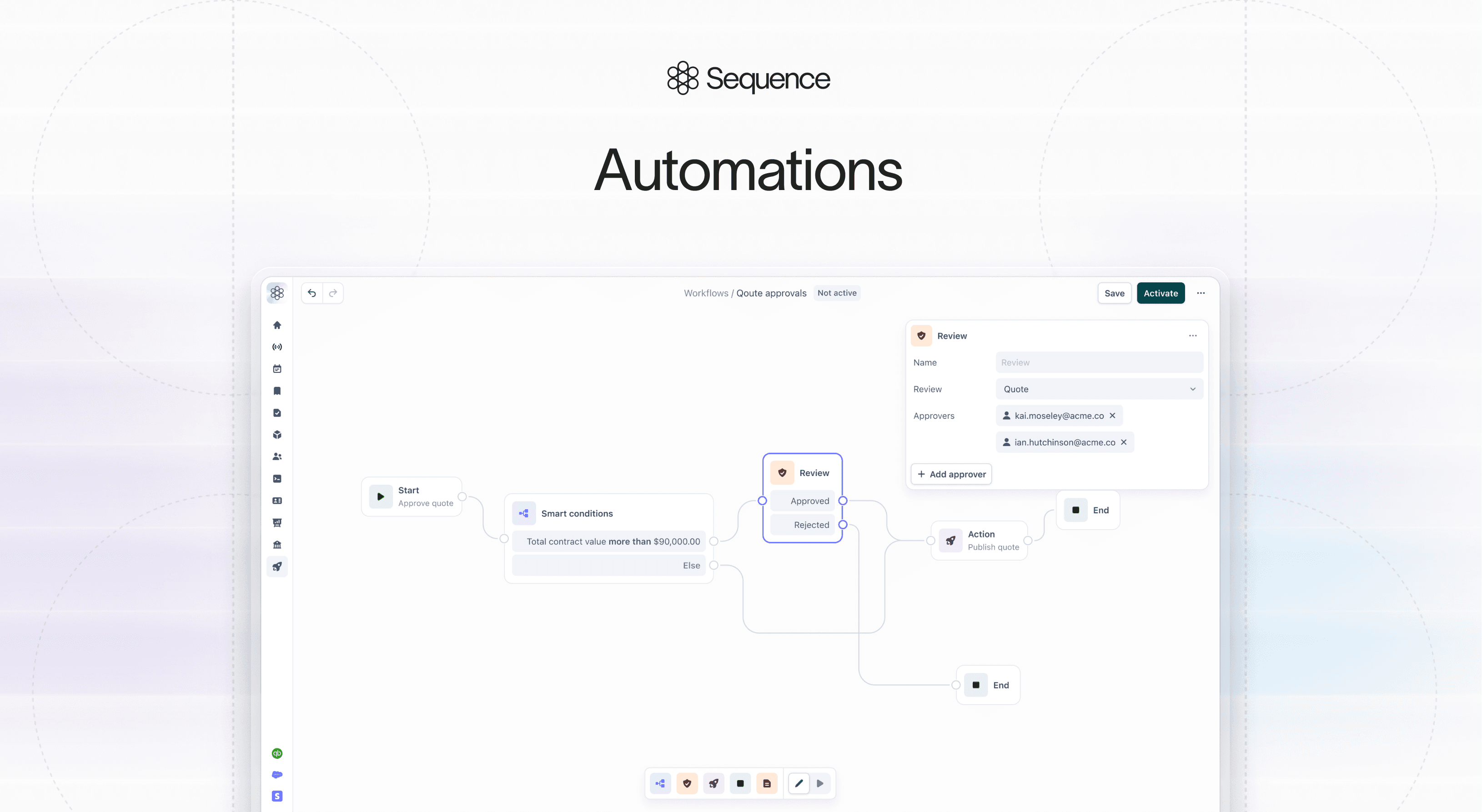
Automations gives revenue teams a visual workflow designer to codify their operational logic and have the system execute it every time, without exception.
Workflows are built from four components:
Triggers are the business event that starts a workflow: a quote submitted, a contract uploaded, a renewal approaching, an invoice overdue.
Conditions are the logic layer: discount above 20%, contract value over $200K, payment terms outside standard. These determine which path the workflow takes.
Actions are what the system executes automatically: routing a review, notifying an account manager, publishing an approved quote, sending a collections sequence.
Reviews are where human judgment enters. When a workflow reaches a decision point that requires a person, it pauses and surfaces the task immediately in Watchtower, with full context attached. The reviewer sees exactly what they need to decide, not a forwarded email chain they have to reconstruct.
Every workflow runs with full visibility. Teams can see where every deal sits and who is responsible for the next step.
Built from the Hardest Problem First
We started with conditional quote approvals because they're a complex coordination problem in the quote-to-revenue lifecycle, and because solving them correctly required building the underlying workflow engine that now powers everything else.
The conditional logic alone is non-trivial. A workflow that handles a $50K standard deal differently from a $500K non-standard deal, routes each to different reviewers, escalates if there's no response within a defined window, and then automatically publishes the quote on approval is not a simple notification system. It required building a full workflow engine with conditional branching, sequential routing, escalation logic, and state management. That engine is now the foundation for every operational workflow across the revenue lifecycle.
What Revenue Workflow Automation Enables Beyond Approvals
The same engine that handles quote approvals is already being extended across the full quote-to-cash workflow:
Contract intake: AI reviews contracts uploaded to Sequence and routes them for the right approval before billing begins. No manual triage.
Collections: Overdue invoices trigger follow-up sequences automatically, with escalation paths if early attempts go unanswered.
Renewals: Approaching renewal dates trigger outreach and internal escalation, so nothing slips through at the end of a contract term.
Invoice anomaly detection: Unusual invoices are flagged before they reach the customer, giving finance a chance to review before the relationship is affected.
Custom integrations: Webhook nodes connect workflows to external systems, so Sequence can trigger actions in your CRM, ERP, or communication tools.
The pattern is consistent: define the logic once and the system applies it consistently at scale. No institutional knowledge required. No coordination overhead.
Workflows Today, Agents Next
Automations is the first step in a broader initiative at Sequence, with workflows shipping now and agents to follow on the same foundation. Both humans and agents will use these workflows to get the revenue work done.
The important distinction is what agents are for. They won't be doing your billing - the billing engine handles that, as it has for teams managing the most complex B2B pricing in the market. Agents will handle the coordination work: the manual steps between your systems that currently rely on someone remembering to act. Rather than building agent behaviour from scratch, they'll get access to the workflows and tools already built and refined inside Sequence, running processes end-to-end when the path is clear and pausing for human input when it isn't.
Watchtower is the control layer for both. Whether a human is reviewing a non-standard approval or an agent is running a collections sequence, your team can see exactly what happened, why it happened, and approve or override before anything lands. Every action flows through the same audit trail, and nothing happens outside the guardrails your team has already defined.
Why a Unified Data Model Makes This Possible
Revenue workflow automation only works cleanly when your quote, contract, billing, and invoicing data live in the same system. When those systems are separate, a CPQ bolted onto a billing tool feeding into a rev rec layer connected by integration, the workflow engine can't evaluate conditions accurately because the information it needs is split across systems that don't always sync in real time.
Sequence was built as a single data model across the full quote-to-revenue lifecycle. Automations is the operational layer on top of that foundation, and the two aren't separable - which is why assembling this capability through acquisitions is harder than it looks. [We've written about that in more detail here.]
Frequently Asked Questions
What is revenue workflow automation?
Revenue workflow automation is the practice of codifying the operational logic around your revenue processes - approvals, reviews, collections, renewals - and having software execute those workflows automatically. Teams define the rules once and the system applies them consistently at scale, rather than relying on manual follow-up and tribal knowledge.
How is Sequence Automations different from a general workflow tool like Zapier or Make?
General workflow tools connect apps and trigger actions across them. Sequence Automations is built specifically for the quote-to-revenue lifecycle, with native access to your quoting, contract, billing, and invoicing data in a single system. That means conditions can evaluate real deal data - discount percentage, contract value, payment terms - rather than just surface-level triggers.
What triggers can I use in a Sequence Automation?
Automations can be triggered by any significant event in the revenue lifecycle: a quote being submitted, a contract being uploaded, an invoice becoming overdue, a renewal date approaching, or custom conditions based on deal attributes. New trigger types are being added regularly.
Does Automations replace human approval processes?
No, and it's not designed to. Automations codifies when human judgment is required and surfaces those moments immediately to the right person via Watchtower, with full context. The goal is to eliminate the coordination overhead around approvals, not the approvals themselves.
Where do agents fit into this?
Workflows are the first release. Agents are coming, and they'll run on the same workflow engine - using the tools and processes already built into Sequence to automate the coordination work that currently runs on manual follow-up. Watchtower gives full visibility into agent actions alongside human reviews, so your team always knows what's happening and why.
Is Automations available now?
Sequence Automations is available now, starting with conditional quote approval workflows. Additional workflow types - contract intake, collections, renewals, invoice anomaly detection - are rolling out across Q2 2026.
Book a demo to see it in action.