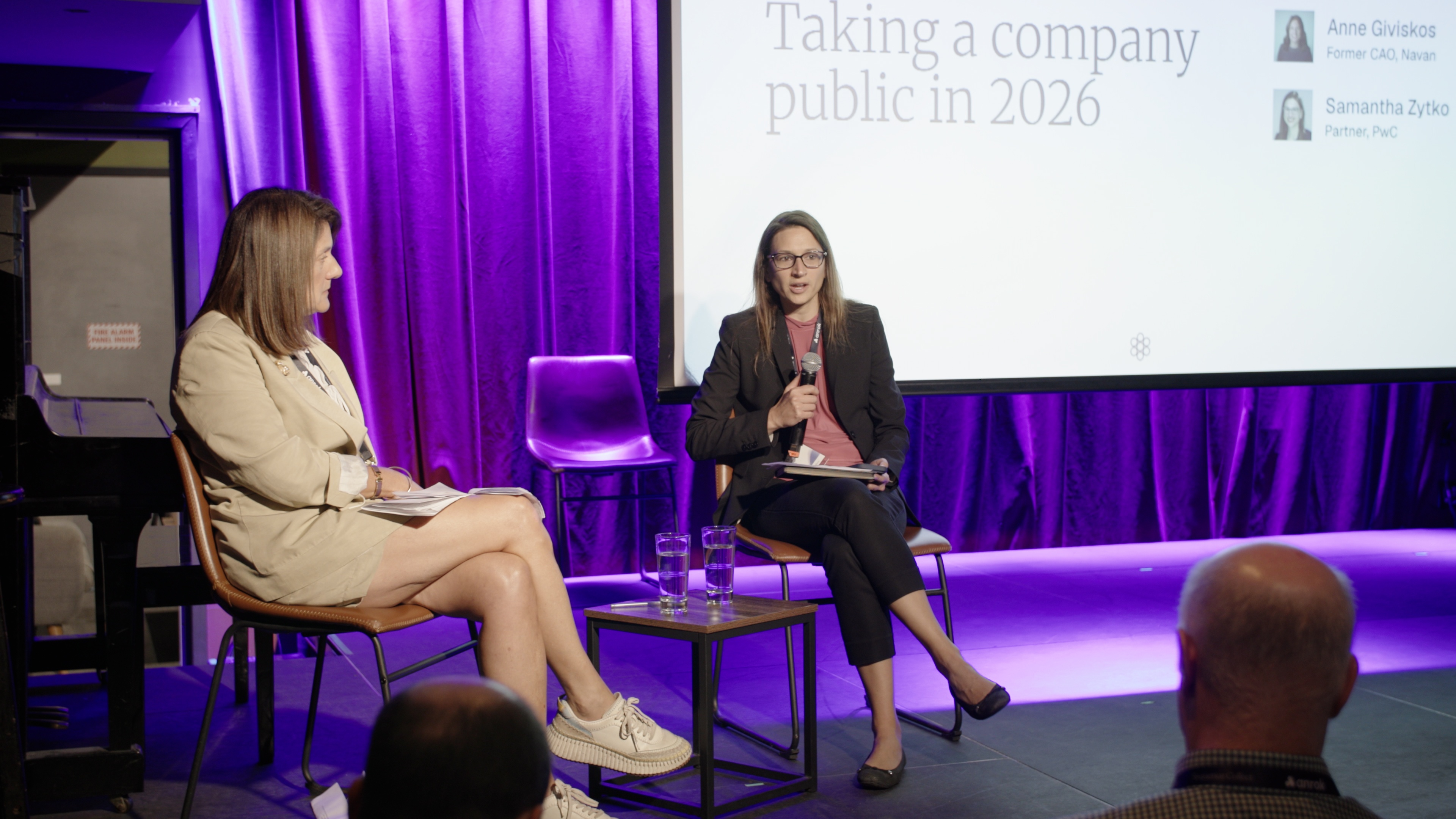
Sequence Collect 2026: Taking a company public in 2026

Anne Giviskos took Navan public last October, 6 months after producing 2 years of audited financials from a standing start. At Collect 2026 she went through how with Samantha Zytko, Partner at PwC, and almost all of it was decided years before the S-1.
The IPO is a point in time
Anne says this early and comes back to it. The listing is a date. The organisational maturity underneath it carries on long after the bell.
Which is why she is blunt about who owns it. Finance is the backbone because finance owns the numbers and has usually done it before. Most of the roadblocks that surface during a filing sit outside finance though, in someone else's process or data or team. At Navan the COO co-led the IPO project and the president running go-to-market was in it too, so when something jammed there was someone senior who could clear it.
Her advice to finance leaders is one line. Don't go it alone.
Change the auditors before you need them
When Anne joined, the financial statements had no closed audits. She got FY23 done. Then she decided to change auditors anyway, ran an accelerated RFP to do it, and came out of that with 6 months to produce 2 years of audited financials for the S-1.
Most people would leave an auditor change until after the filing. Anne calls that kind of decision a reflex, built from doing this 3 times before. Knowing which problems get worse if you carry them forward is most of what a repeat operator brings.
The second reflex is tax. She got caught by it early in her career and now lifts the covers on it at the start of every process, looking for reserves and contingencies before anyone else goes looking.
An accounting mistake at a public company moves the stock
Anne's word for a booking or policy error at a private company is an oopsie. You find it and fix it and nobody is hurt.
The same mistake at a listed company gets priced in within a day. So her first long pole at Navan was pulling every accounting policy back out and reading it fresh, with her team and with the new auditors, before anyone outside got to read it.
There are 5 definitions of your most important metric
This was her second long pole and it is the one most Series B and C operators will recognise.
Internally, Navan had 5 definitions for every indicator. All of them the same, none of them quite the same. Marketing had one, finance had another, the board deck had a third. That survives right up until the quarter you have to publish the number, repeat it 3 months later, and explain any movement in it to people who write about you for a living.
The fix was landing one definition with the business, then building the structure that reproduces it every quarter without anyone relitigating it. Sam made the related point that the same discipline now applies to KPIs and non-GAAP measures, not only the GAAP numbers. Public companies are putting internal controls around both.
Internal controls only work if people can say what one is
Anne describes internal controls as a language, and a language that lives entirely inside finance and audit. The controls themselves depend on people in sales, support and engineering doing something differently. If those people can't say what a control is in their own words, the control is decorative.
The same problem shows up with everything else that arrives with a listing. Ask most of a company what material non-public information means and, in Anne's phrase, it's vegetable soup.
Navan had a culture of sharing information broadly, and going public meant taking a lot of that away. Anne had to explain why people should want less information rather than more, and why the honest answer to "why don't I get that anymore" is that having it can get you in trouble.
So she used Mean Girls. The burn book sits with a small group, everyone else is better off knowing nothing, and the day it gets out is the day it explodes. People remembered that one.
Right players, right positions
Anne changed out her global controller and her technical accounting director before Navan filed. Her words on the people already in those seats are that they were good, and that they couldn't prepare the company for the steps that were coming.
The other half of the job was keeping the people who already had the trust of the business, like the payments lead who came from Amazon and who the commercial teams actually listened to. Credibility inside a company is not something a new hire arrives with.
She thinks about the whole thing the way Billy Beane thinks about a roster. A view of what the team should look like, the right players in the right positions, and someone who can see 5 steps ahead.
Sam's addition is the part that catches people out on budget. SEC reporting and investor relations are roles that simply don't exist at a private company, and every one of them is a hire, a co-source or an outsource decision made under time pressure.
The forecast has to survive 2 audiences
Navan is largely usage-based, seasonal, with mixed contract types. That is hard to forecast and harder to explain.
Anne's FP&A team had to do both. First the board needed a forecast credible enough that they believed the company could go public at all. Then the same model had to hold up at the analyst day, quarter by quarter and then out years. By the time Navan met analysts, the first public quarter was practically baked.
The plan held through a government shutdown
In September 2024 Anne told the Navan board the company would go public in mid-October 2025.
They went on 30 October 2025. The gap was a government shutdown. The way the rule was written, Navan couldn't get effective, so the company went to the SEC alongside Nasdaq and its investors and got the language tweaked enough to move.
That was 13 months of notice, delivered 2 weeks late, through a shutdown. Anne credits the planning and the public commitment for the credibility it bought, and the credibility is what made the rest of it work.
If you are 2 or 3 years out
Anne's closing advice was about the deal desk. Contracts structured so revenue recognition falls out of them cleanly, rather than being reconstructed by someone in a spreadsheet 18 months later. Then the chart of accounts, which accounting owns and FP&A has to use, so the 2 teams build it together or live with the seam forever. Then cash, which she says is king, meaning know where all of it is and when it arrives so you never get into a squeeze.
All of that is ordinary housekeeping, and doing it early is what makes the IPO itself cheap.
It is also why this comes up in most of our customer conversations. Billing, invoicing and revenue recognition set up properly, traceable back to the clause in the contract they came from, is a thing you either did or didn't do 3 years earlier.
Book a demo