Sequence Collect 2026: Deterministic vs AI
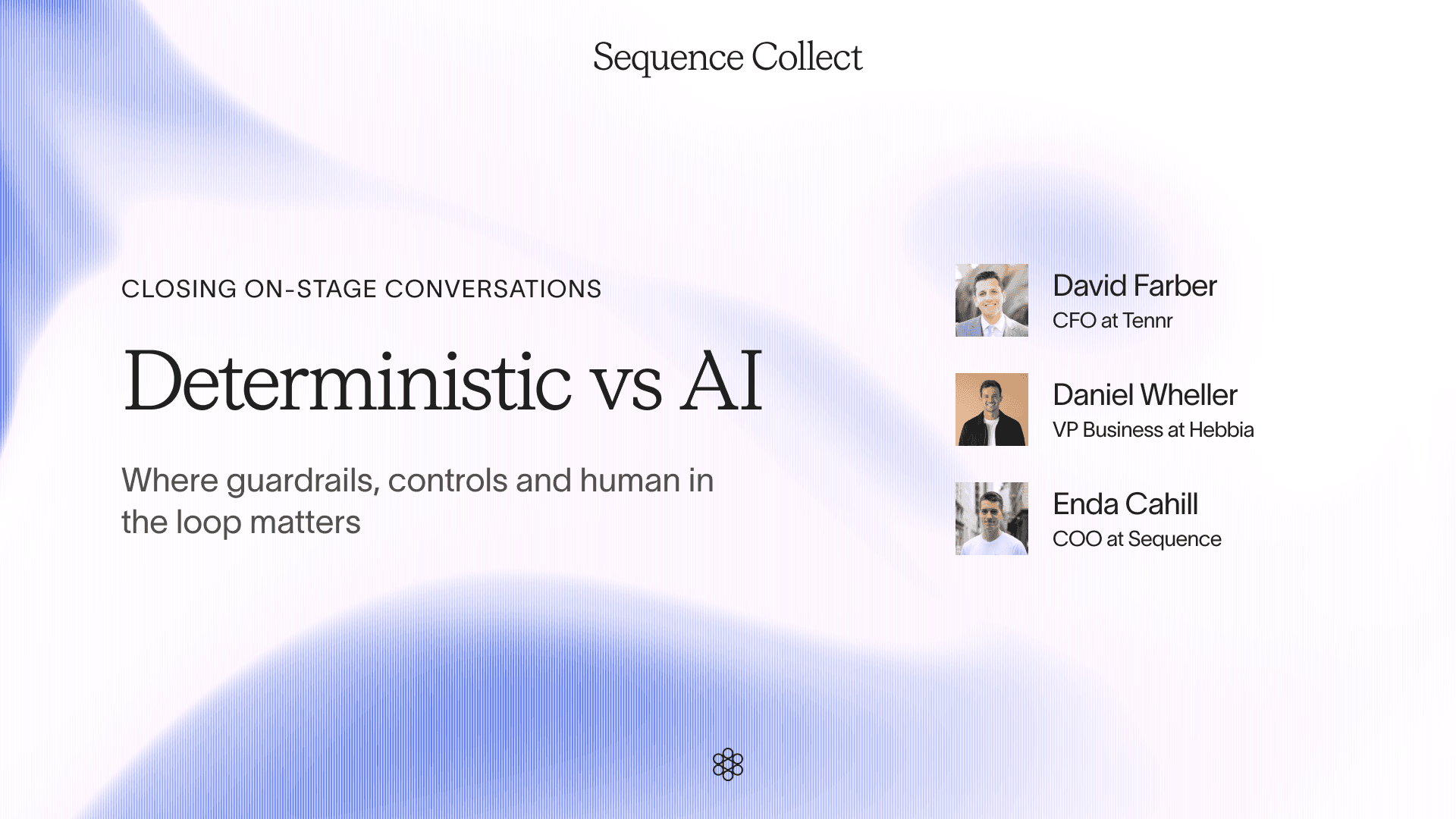
David Farber is CFO at Tennr, running a four-person finance team he reckons could carry three times its current volume, and Daniel Wheller spent seven years at Palantir before building out Hebbia's forward deployed and post-sales functions. On September 9th, at Sequence's Collect 2026, they sat down with Enda Cahill to draw the line between the work that has to stay deterministic and the work agents should be doing, from pricing when inference is your biggest cost driver to whether a task can be evaluated at all.
Where finance should stay deterministic
David Farber is CFO at Tennr, where a four-person finance team supports a fast-growing healthcare automation business. Daniel Wheller is VP of Business and Strategy at Hebbia, working with financial services firms where AI is increasingly being used across research, diligence and analysis.
At Collect 2026, they sat down to talk through where AI can take work off finance teams, where deterministic logic still matters, and how that changes the people they hire.
Use AI to prepare the work, not make every decision
David estimates around 95% of Tennr’s finance processes are still deterministic. Where AI has made a difference is the work that happens before someone needs to review or make a decision.
For a weekly AR review, for example, the team can bring together invoices, collections, bank statements, customer emails and Slack messages and have an agent collate and summarize them. The team still reviews everything together, but starts with the accounts that actually need attention rather than spending time pulling the information together.
Danny sees a similar split in financial services. An EBITDA reconciliation can use deterministic logic to calculate an adjustment, while deciding what should be adjusted and why still requires judgment.
The goal isn’t to make every finance process agentic. It’s to separate the parts that should always produce the same answer from the parts where AI can organize the work and help a person make the final call.

Usage-based pricing needs a track record
Hebbia’s costs change depending on how customers use the product, from the workflows they run to the models behind them. That makes pricing closely tied to product and model decisions rather than something finance can set once and leave alone.
Danny says the difficult part of moving to consumption-based pricing is trust. Without historical usage data, it’s hard to tell a customer what they’re likely to spend or give them a comparable customer to benchmark against.
Hebbia can start a customer at a fixed price, show them their actual consumption over the year and use that history to make future usage more predictable.
Tennr takes a similar approach around what David calls its atomic unit: the patient. The team can estimate how much work a given patient volume will generate, sell against a commitment and then match the underlying model and vendor costs against the same unit as usage grows.
Finance hires need to understand the answer AI gives them
Tennr assumes candidates will use AI during its finance case studies. David isn’t trying to test whether someone can solve the exercise without it; he wants to know whether they understand the answer well enough to explain it.
The team deliberately includes things it expects AI to get wrong and asks candidates to reason through them. The same people also need to understand the accounting underneath the analysis, because that is what lets them know where the data came from and whether the output makes sense.
Danny is seeing a similar shift at Hebbia and across its customers. Junior generalist work is easier to augment with models, while deep knowledge of workflows, controls and industry-specific edge cases becomes harder to replace.
AI can do more of the work, but the people using it still need enough domain knowledge to know when it got the work wrong.