Automated Revenue Recognition for SaaS: How Sequence Works
Automated revenue recognition means no more manual ASC 606 journals. Here's how Sequence handles this end-to-end for B2B SaaS finance teams with custom contract
Revenue recognition has always been the trickiest part of the finance stack. While billing automation has solved the "when to charge customers" problem, recognizing that revenue correctly in your books remains a manual, error-prone process that consumes days of finance team time every month.
Today, we're excited to launch Sequence Revenue Recognition – purpose-built for modern B2B SaaS companies with usage-based pricing, custom contracts, and complex deal terms.
The problem with manual revenue recognition
Finance teams at growing SaaS companies spend countless hours each month creating journal entries manually. Here's what we consistently hear:
"Our month-end close takes forever" – Finance teams manually calculate journal postings for hundreds of contracts with different terms, billing schedules, and pricing models.
"We're always worried about compliance" – ASC 606 and IFRS 15 requirements are complex, and manual processes introduce audit risk.
"Our billing system doesn't handle recognition" – Most billing platforms focus on invoicing but leave revenue recognition as an afterthought.
"We can't scale our current process" – What works for 50 customers breaks down at 500.
Revenue recognition, designed for modern pricing
Sequence Revenue Recognition isn't just another accounting module bolted onto a billing system. It's built from the ground up to handle the complexity of modern B2B SaaS pricing.
Flexible recognition methods:
- Straight-line: Perfect for subscriptions and fixed-term contracts
- Usage-based: Recognize revenue as customers consume your service
- Point-in-time: For implementation fees and one-off deliverables
- Milestone-based: Full control over project-based revenue timing
Complex scenarios, handled automatically
- Milestone based revenue recognition.
- Product-level and invoice-level discounts with correct allocation.
- Credit notes that reverse revenue from the right accounts
- Automatically allocated minimum fees and true-ups with point-in-time recognition.
- Export journal entries as CSV files formatted for your specific ERP system.
- Replace manual journal postings with a single file upload.
How it works
Revenue Recognition integrates directly with your existing Sequence billing schedules and invoices.
Here's the flow:
- Automatic recognition rules: Set recognition methods at the product level or overwrite per invoice line item.
- Daily journal generation: Revenue is recognized based on actual service delivery, not billing timing.
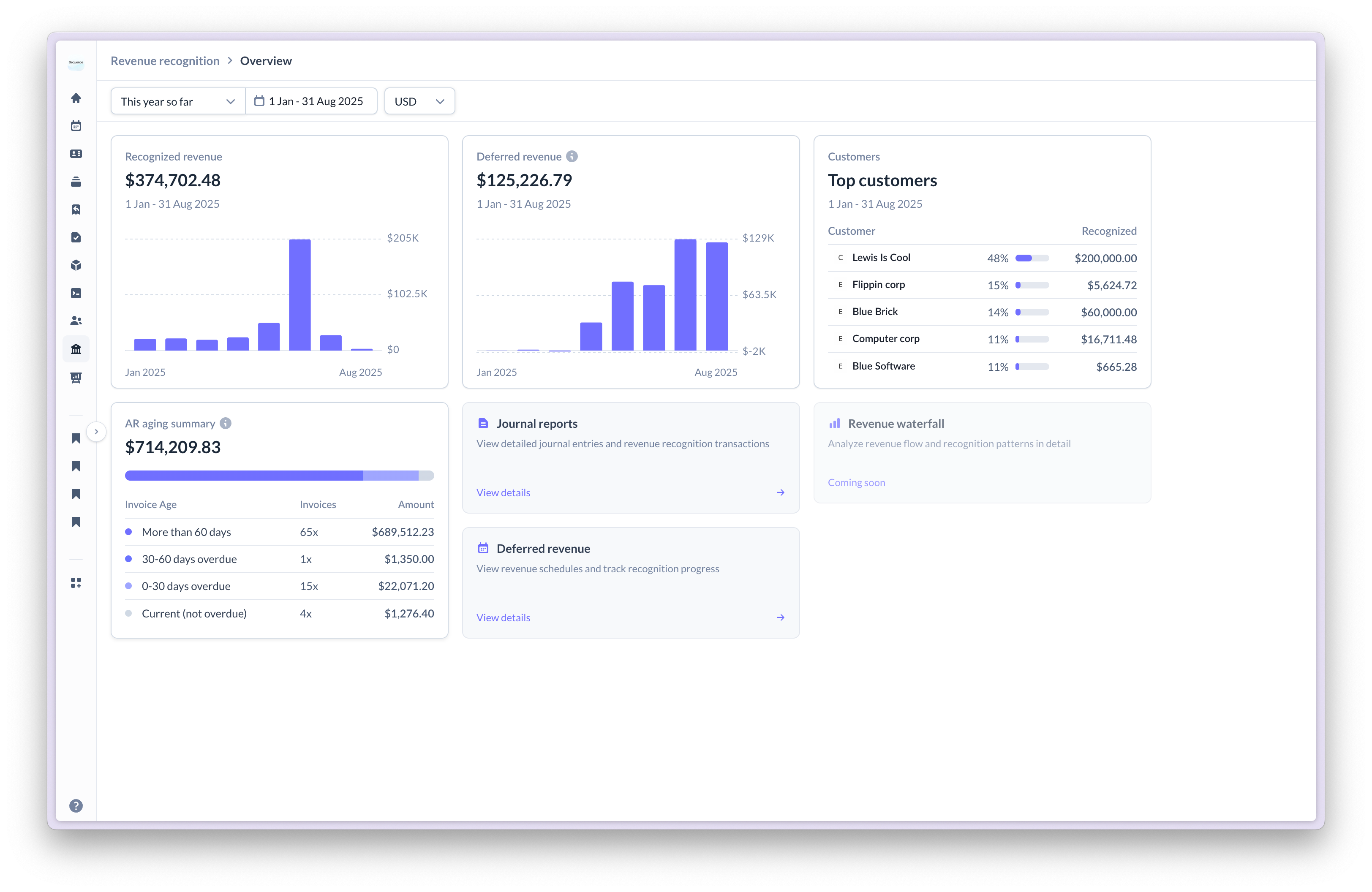
- Monthly reporting: View detailed journal reports with full audit trails
- One-click export: Download formatted CSV files for your ERP system
Built for compliance
Revenue Recognition follows ASC 606 and IFRS 15 standards out of the box:
- Standalone selling price allocation for discounts and minimum true up fees.
- Performance obligation tracking for complex contracts
- Full audit trails with detailed journal entries and supporting documentation
What's next
Revenue Recognition is available - reach out to our team to get access.
We're continuing to expand capabilities based on customer feedback:
- Multi-entity support for companies with complex legal structures
- Advanced reporting with revenue cohort analysis and forecasting
- Additional ERP integrations beyond CSV export
Get started
If you're already a Sequence customer, reach out to our team to get started. Ready to automate your revenue recognition process? Schedule a call with our team to see Revenue Recognition in action.
Frequently Asked Questions
Q: What is automated revenue recognition for SaaS?
Revenue recognition is the accounting process of recording when revenue is 'earned' — governed by ASC 606 (US GAAP) and IFRS 15. For SaaS, this means revenue from an annual contract is recognised monthly over the contract term, not when the invoice is paid. Sequence automates this calculation and creates the journal entries in your accounting software automatically.
Q: How does Sequence handle ASC 606 compliance?
Sequence automatically generates a revenue schedule for every contract based on its billing structure — recognising revenue evenly over the term, or based on usage if applicable. Journal entries are posted to your general ledger (Xero, QuickBooks, or NetSuite) in real time, with a complete audit trail.
Q: Can Sequence integrate with my accounting software?
Yes. Sequence integrates natively with Xero, QuickBooks Online, and NetSuite. Every invoice, credit, and contract amendment in Sequence creates the corresponding journal entries in your accounting platform automatically.
Q: Do I need a dedicated accountant to set up Sequence revenue recognition?
No. Sequence's revenue recognition module is configured directly from your billing contracts — you define the recognition policy (straight-line, usage-based, or milestone) and Sequence applies it automatically across all contracts. Most finance teams complete the setup in a single onboarding session.